Software that knows: from guideline to application
Part 5 of the series “Software that knows”.
Recap
Parts 1 to 4 described the approach: capture knowledge, make it formal and explicit, and derive the software from it. This part applies it end to end, to published clinical guidance, and shows the result as a working application.
- Demo: lab.almilo.com/imci-fever
- Code: github.com/almilo/software-that-knows/imci-fever
- In detail: What’s in a field and From statements to a working form follow one field from the knowledge model into the running application.
Disclaimer: the application is a demonstration. It is not a medical device and has not been reviewed by a clinician.
The use case
A health worker assesses a sick child aged 2 months to 5 years. The application asks the questions, classifies the case and lists the treatments, following the World Health Organization (WHO) guidance for fever, malaria and measles, as published in its digital adaptation kit (DAK) for child health. The DAK builds on the WHO Integrated Management of Childhood Illness (IMCI) guidance.
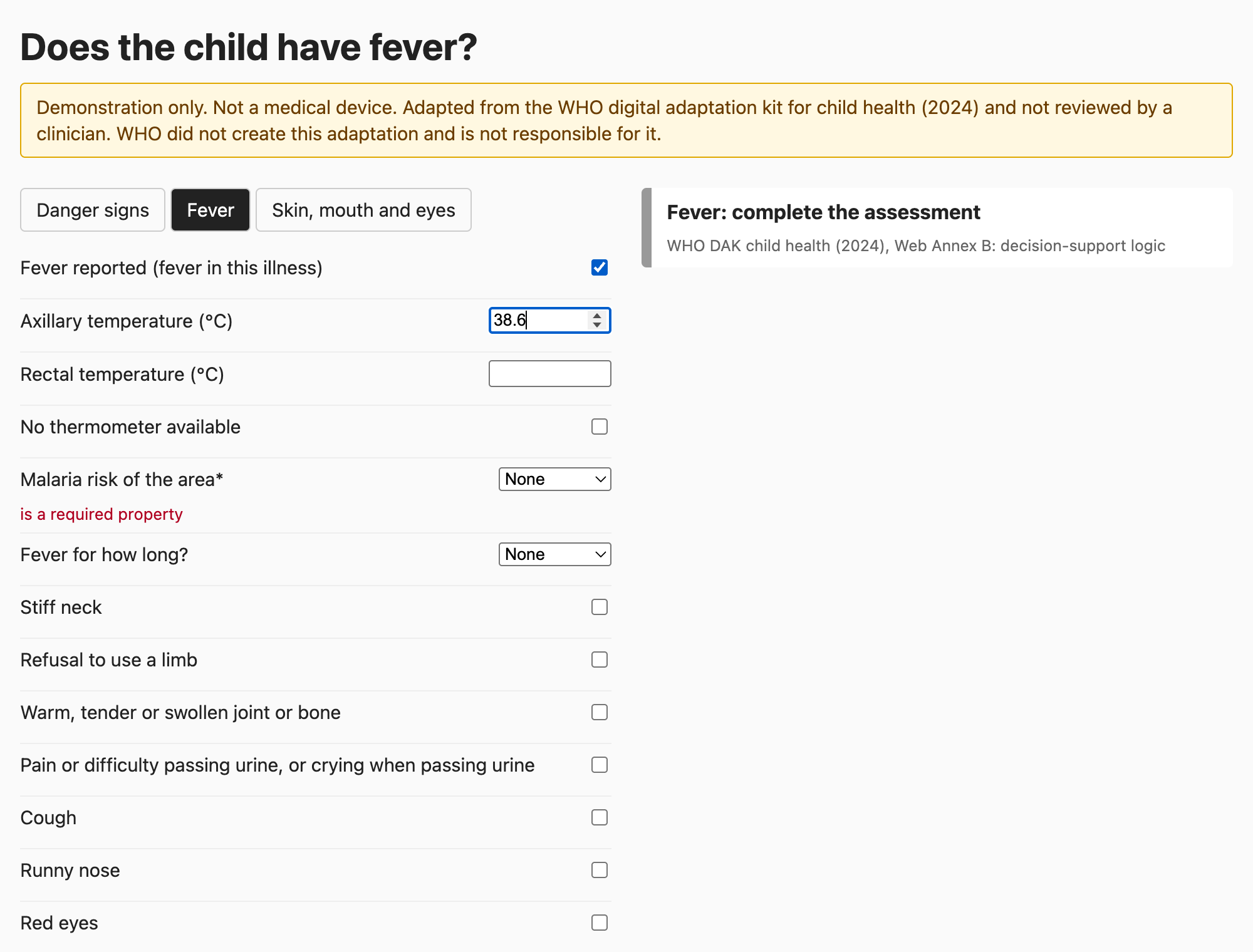
The assessment starts with the fever questions. After the child is recorded with fever and an axillary temperature of 38.6 °C, new questions appear: the malaria risk of the area, how long the fever has lasted, and signs of other infections. The result panel asks for the assessment to be completed.
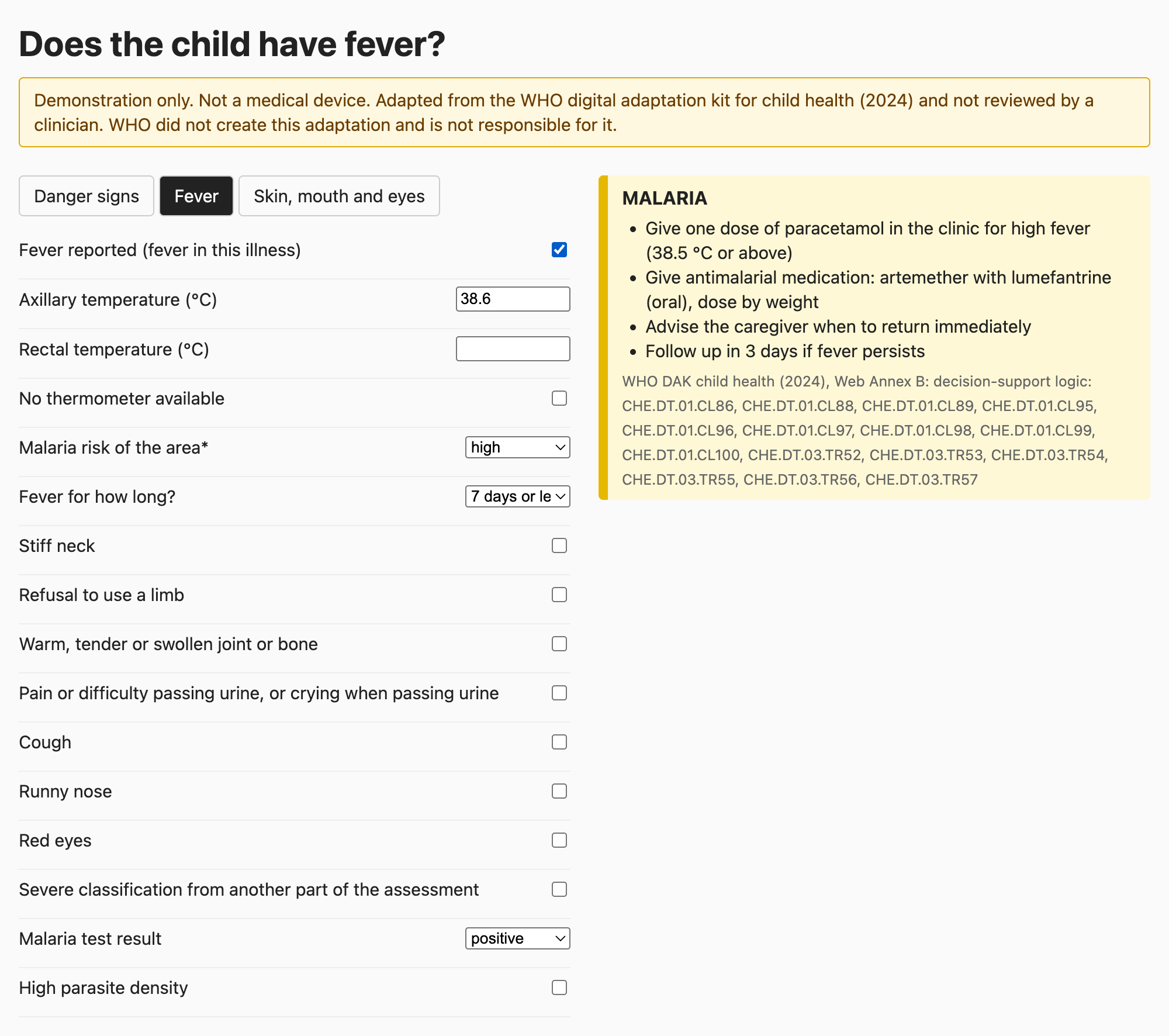
The area has a high malaria risk, and the rapid test is positive. The result is MALARIA, with its treatments: paracetamol in the clinic for the high fever, an oral antimalarial, advice on when to return, and a follow-up in 3 days. Below the treatments are the IDs of the WHO rules the result comes from.
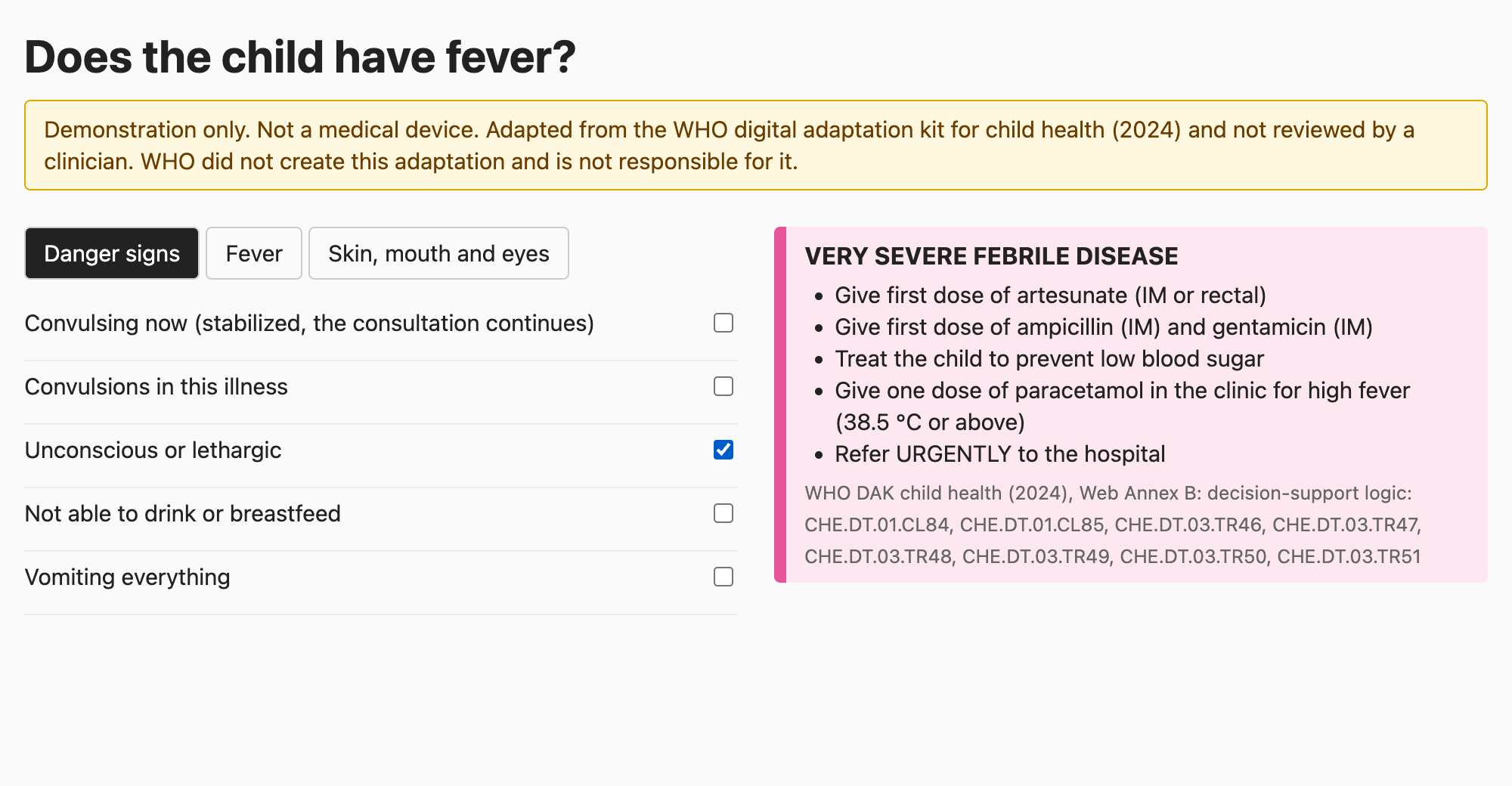
A danger sign changes the result. With “unconscious or lethargic” checked, the child is classified as VERY SEVERE FEBRILE DISEASE, with first doses of medication and urgent referral.
The application covers 35 questions, 4 decision tables, 9 classifications and 22 treatments.
Where knowledge is found
Organisations already hold much of their knowledge in written form: standard operating procedures (SOPs), guidelines, regulations, product specifications and decision tables. The rest sits with people (part 4). An organisation would start from its own documents. This example uses a public source instead.
The source is the WHO DAK for child health (2024). A DAK turns WHO clinical guidance into requirements for digital systems. Two of its annexes matter here:
- Web Annex A, the data dictionary. Every data element, with an ID, a definition and its allowed values.
- Web Annex B, the decision-support logic. Decision tables in which every row has an ID.
A data element, from Annex A:
| ID | Label | Input options |
|---|---|---|
| CHE.B25.H.DE01 | Malaria risk | High malaria risk, Low malaria risk, No malaria risk |
A decision row, from Annex B:
| ID | Conditions | Classification |
|---|---|---|
| CHE.DT.01.CL86 | “Fever” = TRUE; “Malaria risk” = “High malaria risk”; severe classification = FALSE; “Malaria test results” = “Malaria-positive” | Malaria |
Against the three checks from part 3:
- Explicit: yes. The rules are written down, each with an ID.
- Readable by experts: yes. They are tables in spreadsheets.
- Formal: partly. The structure is regular, but the conditions are text in cells. A program cannot execute them as they are.
The missing step is making the knowledge formal. That is what the knowledge model adds.
Two models
The application rests on two models with different purposes.
The knowledge model: the domain
The knowledge model describes the domain: the questions, the conditions, the classifications and the treatments, each linked to the DAK entries it comes from. It is one Turtle file of about 650 lines, in the format introduced in part 4.
A question, and when it is asked:
[ sh:path imci:highParasiteDensity ; sh:datatype xsd:boolean ;
  sh:name "High parasite density" ;
  prov:wasDerivedFrom dak:CHE.B24.G.DE71 ;
  imci:shownWhen [ imci:field imci:malariaTest ; imci:equals "positive" ] ]
The MALARIA row of the fever table:
imci:Malaria a imci:Classification ;
  rdfs:label "MALARIA" ;
  imci:severity imci:Yellow ;
  prov:wasDerivedFrom dak:CHE.DT.01.CL86 , dak:CHE.DT.01.CL88 , ... ;
  imci:matchesWhen [ imci:allOf (
    imci:malariaApplies
    [ imci:anyOf (
        imci:hasSevereClassification
        [ imci:field imci:malariaTest ; imci:equals "positive" ]
        [ imci:field imci:malariaTest ; imci:equals "unknown" ] ) ] ) ] ;
  imci:qualifiers ( imci:MalariaUnconfirmed imci:HighParasiteDensity imci:MalariaLongFever ) ;
  imci:treatments ( imci:ParacetamolHighFever imci:Antimalarial imci:ReferForAssessmentMalaria
                    imci:AdviseReturn imci:FollowUp3DaysFever ) .
Conditions such as imci:malariaApplies are defined once, in the same file, and
reused. Each rule names its DAK rows, so it can be checked against the source
row by row.
The application model: the software
The application model describes the software: which fields the form has, when each one is shown, and the decision tables in a form a program can evaluate. It knows nothing about fever. It is three JSON files, generated from the knowledge model:
schema.json: the fields, their types and their allowed values.uischema.json: the form layout, and when each field is shown.rules.json: the decision tables, their rows and treatments.
The same question, in the application model:
{
  "type": "Control",
  "scope": "#/properties/highParasiteDensity",
  "rule": {
    "effect": "SHOW",
    "condition": {
      "scope": "#",
      "schema": {
        "properties": { "malariaTest": { "const": "positive" } },
        "required": ["malariaTest"]
      }
    }
  }
}
Every condition becomes a JSON Schema: the answers match the condition when they
are valid against it. The form library (JSON Forms)
and the classifier both use these schemas, so no separate rule engine is
needed. The translation is short
(compile-condition.ts):
const field = o.one(c, `${IMCI}field`);
if (field) {
  const name = local(field);
  const equals = o.one(c, `${IMCI}equals`);
  const atLeast = o.number(c, `${IMCI}atLeast`);
  const test = equals ? { const: literal(equals) } : { minimum: atLeast };
  return { properties: { [name]: test }, required: [name] };
}
for (const op of ["allOf", "anyOf"]) {
  const items = o.one(c, `${IMCI}${op}`);
  if (items) return { [op]: o.list(items).map((item) => compileCondition(o, item)) };
}
The generic application
The application renders the form from schema.json and uischema.json, and
evaluates rules.json against the answers. For each table in use, it finds the
matching row and the treatments that apply
(classify.ts):
return rules.tables
  .filter((table) => matches(table.usedWhen, input))
  .map((table) => {
    const row = table.rows.find((r) => matches(r.matchesWhen, input));
    const treatments = row.treatments.filter((t) => !t.givenWhen || matches(t.givenWhen, input));
    // ...
  });
Simplified; the full function also handles pending tables, qualifiers and sources.
| Part | Lines | Contains |
|---|---|---|
| Knowledge model | about 650 | The domain: questions, rules, treatments, sources |
| Generator | about 250 | Knowledge model to application model |
| Application | about 200 | Form, classifier, result cards |
All the medical content is in the knowledge model. The generator and the application contain none.
Stochastic and deterministic
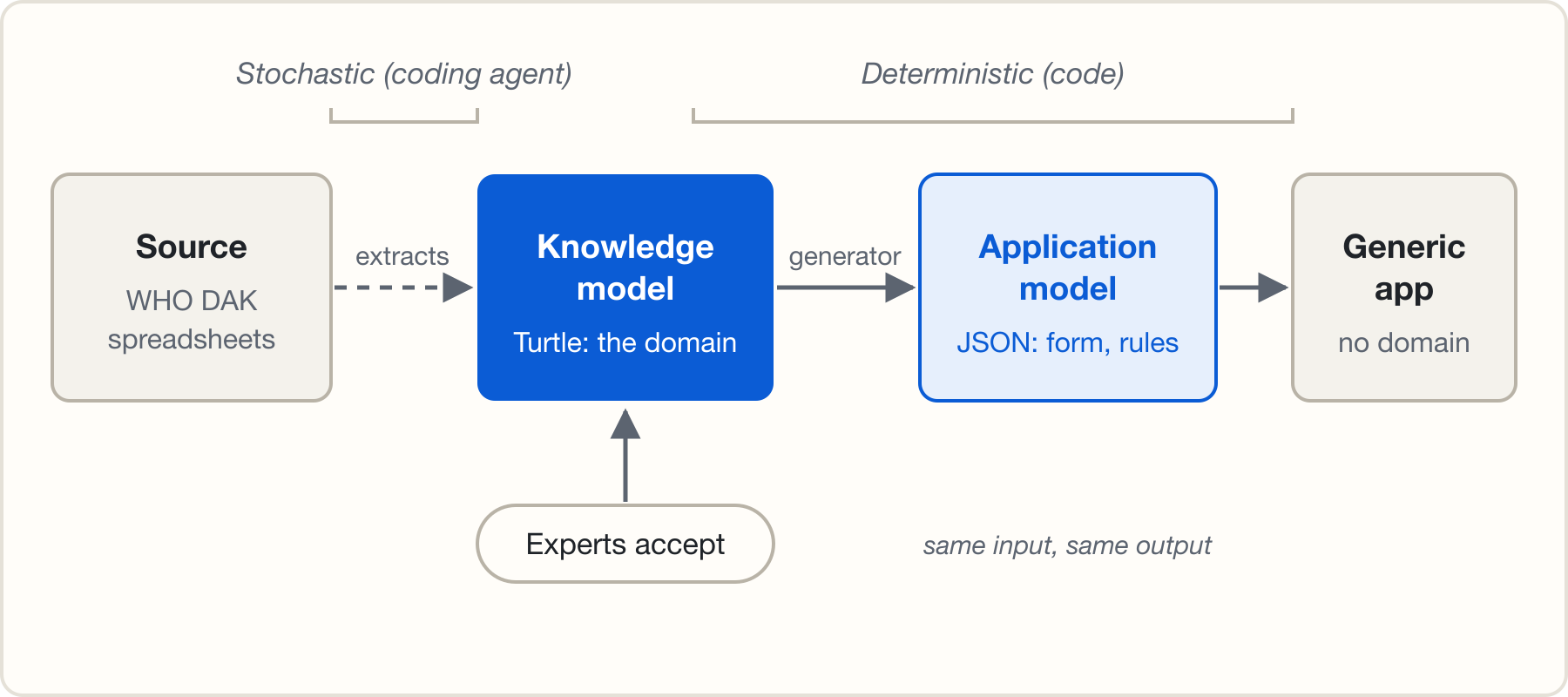
Stochastic (coding agent):
- An agent reads the DAK spreadsheets and writes the knowledge model.
- An agent wrote the generator and the application, once.
- The output of each run can differ, so it is reviewed before it is used.
Deterministic (code):
- The generator turns the knowledge model into the application model.
- The application renders the form and evaluates the rules.
- The tests check clinical paths and general properties, such as “every pink result refers urgently”.
- The same knowledge model always produces the same application.
People:
- Choose the source.
- Accept the knowledge model, rule by rule, against the source.
- Remain accountable for it (part 2).
This is the split described in part 4: agents write the generators once, and generation afterwards is a cheap, deterministic step.
How LLMs make this feasible
Turning guidance like the DAK into a formal model used to need knowledge engineers and significant time. That cost was a main reason expert systems and model-driven development stalled (part 2).
In this example, a coding agent produced the knowledge model from the DAK spreadsheets in one working session. An agent also wrote the generator and the application. The effort moves from writing the model to accepting it, and the total effort is a fraction of what it used to be (part 2).
A hypothetical future version of the DAK shows the effect. The agent updates the knowledge model from the new spreadsheets. Experts accept the change, as a readable difference in one file, with each rule pointing to its DAK row. The generator produces a new application model. The application code stays the same.
How the example fits the earlier claims
| Claim | Part | In the example |
|---|---|---|
| Knowledge can be made formal and explicit | 1, 3 | DAK tables turned into an executable knowledge model |
| LLMs lower the cost of capturing knowledge | 2 | The knowledge model was produced by a coding agent |
| Acceptance by the people who own the knowledge | 2 | Every rule names its DAK row, so it can be accepted row by row |
| One model, several artefacts, all generated | 4 | Schema, form and rules generated from one file |
| Traceability through provenance | 4 | Every result shows the DAK rules behind it |
| Changes land in the knowledge, not in the code | 1 | A new DAK version changes the knowledge model; the application stays the same |
How we’d know it’s wrong
- The application model cannot express what the next domain needs, and domain logic ends up in the application code.
- Accepting a knowledge model rule by rule takes longer than reviewing the equivalent code.
The ideas and arguments in this article are my own. An AI assistant (Claude) helped with drafting, editing and fact-checking. The demo is adapted from the WHO digital adaptation kit for child health (CC BY-NC-SA 3.0 IGO); WHO did not create the adaptation and is not responsible for it.