Software that knows: what knowing means
Part 3 of the series “Software that knows”.
Knows what?
The series is called Software that knows, so it owes a definition of knowing. Data, Information, Knowledge, Understanding and Wisdom are often used as synonyms. They aren’t.
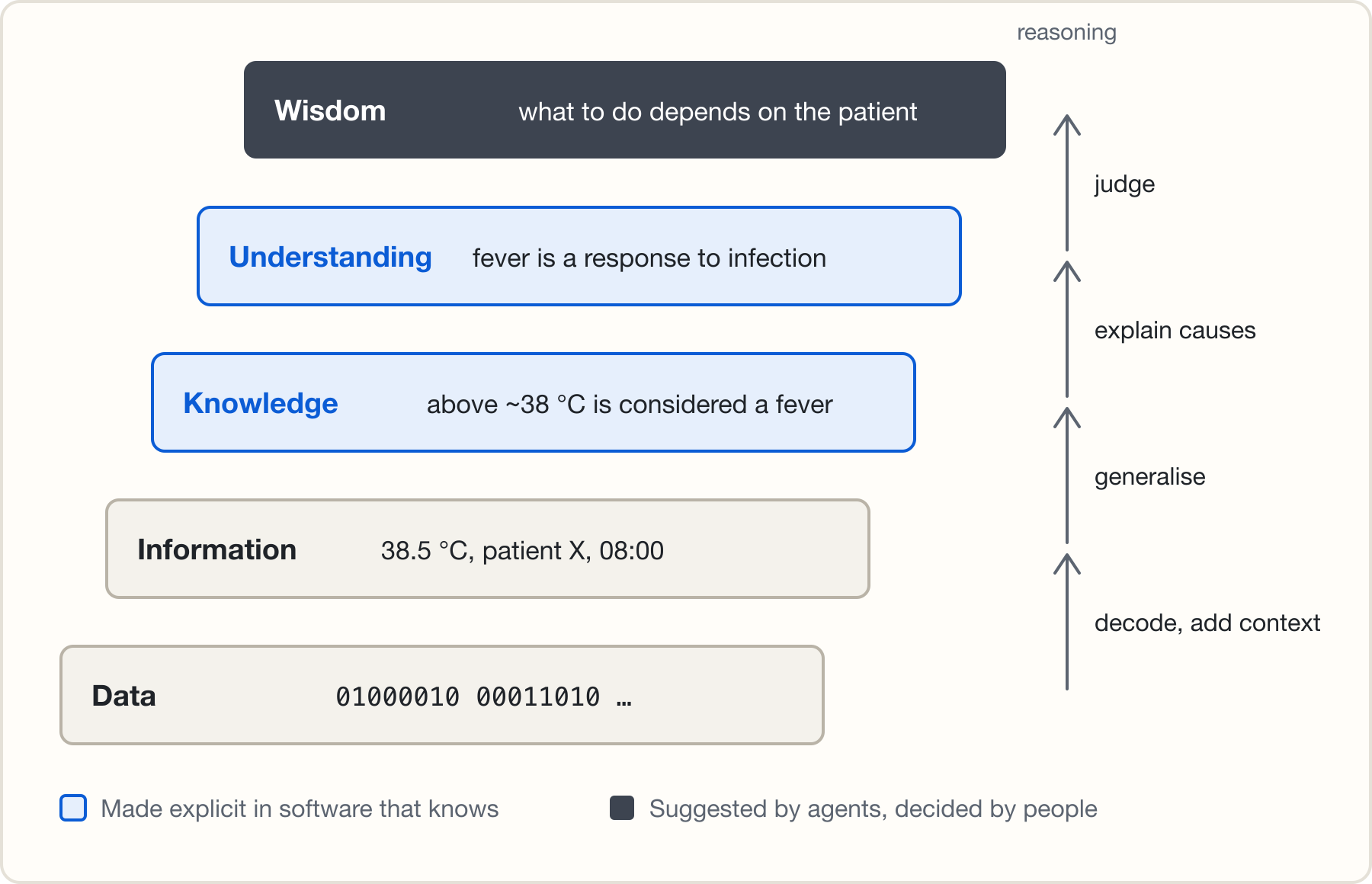
A useful model is the DIKW hierarchy, popularised by Russell Ackoff in 1989. His version has five levels (many later versions drop Understanding and keep four), and each one adds context to the level below. One example runs through all of them.
Data
01000010 00011010 00000000 00000000
Just bits. Read as a 32-bit floating-point number, they are 38.5. Read as an integer, they are 1,109,000,192.
Data is symbols without context. On its own, it answers nothing.
Information
Body temperature of patient X at 08:00: 38.5 °C.
Information is Data with context. In this example, it answers what was measured, of whom and when.
Knowledge
Above about 38 °C, a body temperature is usually considered a fever.
Knowledge is a pattern learned from many cases. It answers how things behave.
Understanding
Fever is the body’s response to infection: a signal, not the problem itself. A newborn’s immune system is immature and chemotherapy suppresses it, so in those patients an infection can escalate quickly.
Understanding is Knowledge of causes. It answers why.
Wisdom
The right treatment depends on the patient. For a healthy adult, rest, fluids and monitoring are usually enough. For a newborn or a patient on chemotherapy, the same 38.5 °C needs immediate medical attention.
Wisdom is Understanding applied with judgement and values. It answers what to do in this situation. (An illustration, not medical advice.)
The steps between the levels
The levels are results. What moves from one to the next is reasoning:
- Data → Information: decode and add context.
- Information → Knowledge: generalise from many cases.
- Knowledge → Understanding: explain causes.
- Understanding → Wisdom: judge, weighing values and consequences.
LLMs make these steps much cheaper, especially the lower ones. Whether that counts as reasoning is debated; the effect is not. With formalised Knowledge, agents can take the top step too and suggest a treatment. The decision, and the accountability for it, stays with people, as argued in part 2.
So, knows what?
- Business applications store Data and present Information well.
- Knowledge is buried in code:
if temperature > 38 then fever. - Understanding (why the rule exists) and Wisdom (when it applies) mostly live in people’s heads.
- Applying Knowledge needs facts about the case at hand: observations, such as the patient’s age or current treatment.
Software that knows means Knowledge made explicit, together with as much of the Understanding behind it as can be written down, applied to observations. Agents can then suggest at the level of Wisdom too; people decide.
The ideas and arguments in this article are my own. An AI assistant (Claude) helped with drafting, editing and fact-checking.